Tuesday, February 09, 2010

Cabin Fever

Everyone knows what it is. At different times for different people cabin fever sets in at some point during the winter. For me, it comes very soon after the cold sets in. The only thing that lets me keep my sanity is looking forward to those breaks in the weather, and each person has their temperature threshold. For some, if the temperature isn't 45 degrees or better they won't go fishing. Others choose to place their cutoff at the freezing barrier, where rod guides start to freeze and make life difficult. For me, 15 degrees is too chilly for sure, if its 20 I may go ice fishing, and in anything over 28 (and sunny) and I will go steelheading.

Looking for the days when the weather pans out is key during the wintertime. People place importance on different elements in the forecast. For me the two most important things to take into account are temperature and barometric pressure. If the instruments measure both of these to be in my favor, I will go fishing.

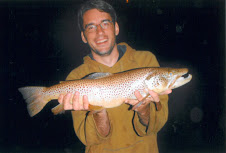
There is something different about the pull of a steelhead or trout during the wintertime. Something about winter solitude, and braving the elements that makes a fish in the net worth its weight in gold. Kind of reminds me of a day on a river north of here, when my buddy Nick and I were the only souls on the river that day. We carefully walked out onto a piece of shelf ice at a good spot and managed to hook into a steelhead and land two nice browns. It seems that when shelf ice is around the steelhead definitely know how to use it to their advantage. Anyway, here are some pictures from that day to get you through until your next break in the weather...


Monday, February 08, 2010

Ice Fishing

You know, some may say that ice fishing is as boring as boring can get. Staring through a hole in the ice, waiting for a bite that may never come can be just that sometimes, but yesterday proved the skeptics wrong.

After arriving at the spot around 3:30, I drilled several holes out in the channel of the river. After fishing there for approximately a half hour without a bite, I moved in towards the edge of the channel. After I spudded out some previously drilled holes, I dropped my lines down and immediately started catching fish.

By myself, I landed around 25 walleye, including an 8 pounder (which I threw back) and a 4 pounder (which I kept). Both of these fish really put up an incredible fight under the ice, with each Walleye taking out several feet of line in each fight. The 8 pounder was a big female, and I let her go because fish that big really don't taste good, and because she was packed full of eggs to procreate. All in all, it was a great day of fishing and it will definitely keep me coming back for more.

Wednesday, February 03, 2010

My Favorite Bug

Although the Au Sable and surrounding river systems have a good number of prolific bug hatches, one in particular jumps to the forefront. The bugs scientific name is Isonychia bicolor, but it is more well known as an Iso, Big Mahogany, or a White-Gloved Howdy. I began to tie up my summer store of these bugs today, starting with comparaduns and eventually moving to a parachute style bug and finally a spinner imitation.

So, you may ask yourself, why is the Iso my favorite bug? The answer is simple: both the volume and longevity of this particular hatch puts it squarely at the top of my list. A true size 10 at the beginning of the hatch, it is best imitated by a size 12 later on as the fish wise up. Starting in mid-June these bugs appear before the famous nighttime Hex bugs on an almost daily basis. On heavy gravel stretches of both the Au Sable and Manistee, anglers can sometimes escape the Hex madness by chasing around these bugs instead. This hatch lasts well into July, and they make a reappearance in late August and early September (usually in smaller sizes). Oh, and big fish will rise to them. Really big fish. In fact, I personally seen my dad land 2 trout near 24 inches on Isonychia patterns, and I know firsthand of a 25 incher taken last year on one by my friend Ken Mers.

They are a swimming nymph, which means that they swim onto shore, shed their nymphal shuck, and hatch on shore. This process is much different than the typical mayfly, which undergo the same insect metamorphosis only in the water instead of on land. Taking this into consideration, many people wonder why I tie the Comparadun and the Parachute in the Iso colors, as both of these style flies represent the immediate post-hatching stages of an insects life. The simple reason I tie them is that they flat out work, in all sorts of conditions.

I could tell you about days on the water landing 6 trout over 17 inches, or 50 plus trout landed on a single Iso pattern, but I won't. Instead, I urge you to look outside the box, take others advice, but also formulate your own original ideas as to how to imitate any given insect. In the case of the Isonychia bicolor , it has paid dividends for me time and time again.


These fish are the last Au Sable trout I have eaten, some five and a half years ago. The Brown at the top was the smallest of four that night, and all of the fish were caught on Isonychia parachutes.

Saturday, January 30, 2010

River Time

Spent some river time on the Saginaw today. Managed to land about 25 fish between us, but only kept one. There are a lot of small fish in the river right now. However, they are a blast and we had pretty much nonstop hits and fish between 3 and 6 o'clock. Jigs tipped with minnows seemed to be the key, those using jigging rapalas weren't having as much luck.

This type of fishing will be one of the first I will introduce my kid to. Consistent action for the whole amount of time we are out there is a big plus, as it will help to get him interested in fishing through catching his quarry...

Thursday, January 28, 2010

Great Day

Today is a great day for tying flies. A balmy 8 degrees outside, its nice to see the pile of Sulphur Comparaduns growing slowly. This has been a great winter for fishing, but not such a great one for wrapping bugs. Oh well. Time spent in neoprene definitely trumps sitting at the desk anyway. I have started preparing the early summer arsenal with the usual array of flies. Hendricksons, Black Caddis, Sulphurs, Little Mahoganies, the list goes on and on. And thats not even counting the big four hatches of June.

Below, you will see a Sulphur Comparadun. It has a white microfibbet tail, cream dubbing, and a coastal deer hair. This is a great pattern from mid-May to mid-June. I have caught some large trout on Sulphurs, and my fair share have come on this exact pattern.

Monday, January 25, 2010

Feast or Famine

Fishing Sunday and Saturday provided a true dichotomy as to how steelhead fishing can be. Saturday was very tough, with one brief hookup on a might-be steelhead and a few trout. Sunday faired much better, with us hooking up a good number of times and landing one steelhead in the morning, but nothing after 1 o'clock (probably because of the cold snowmelt). As my friend Kyle stated, steelheading can be just that: feast or famine.

Some lessons were also learned this weekend. (1) When you think you should not drive down an icy, snow-packed hill, you probably shouldn't. (2) Riding a bike on an icy road leads to falling on your butt (thanks Kyle for that one). (3) Finally, thank god for locals, sometimes they can help you out of a pretty sticky jam. Overall, the fishing was good, the company was better, and the scenery was impressive.

One fish I hooked and lost sticks in my mind because, well, it was just an epic battle. After watching my bobber drop, I set the hook and the fish immediately ran under the log along which my bobber was just floating. Somehow, I managed to keep him free of the tangle. As he ran strongly upstream, I knew I had a battle on my hands. Then, as soon as it ran upstream, it ran back at me at full throttle. As I struggled to pick up line, the fish shot downstream like a bullet towards the next log jam. As I steered the fish away from the logs I was feeling pretty confident. Steelhead don't usually have more than two strong runs (if that even) in the winter, but this fish was different. After avoiding the log jam I positioned myself and the fish in the flat at the end of the run, right upstream of a heavy riffle. The fish decided it had enough, and headed right into the riffle, bending a 2x strong scud hook to the point where it lost its hold and the fish came off. These fish are why we come back, why we chase these chrome bullets in the freezing rain and sleet. Its all for the battle my friends...


Here is a beautiful hen taken on an egg pattern from this weekend

Thursday, January 21, 2010

Thaw

The thaw is coming
It must be true
I'm hoping to find
That chrome and blue

The flowing river
The snowy hills
Just need some trout
To cure my ills

A writhing fish
Of cold tough steel
Thats enough
To get my fill

Once my bobber
Gets submerged
My mind and thoughts
Will soon be purged

Of all the thoughts
That fill my head
Then soon there's one:
It's "Steelhead."